Introduction
Artificial Intelligence is rapidly shifting from assistive tools to autonomous systems. Traditional AI applications respond to prompts, generate outputs, or classify inputs. Agentic AI systems, by contrast, are designed to act, plan, decide, and execute multi‑step workflows with minimal human intervention.
This article explains Agentic AI from an engineering perspective — focusing on architecture, components, and production realities rather than marketing terminology.
From Copilots to Agents
Early AI tools functioned as copilots: they helped humans write code, summarize documents, or answer questions. These systems were reactive and single‑step.
Agentic systems introduce:
- Goal‑driven execution
- Multi‑step planning
- Tool usage
- Memory persistence
- Autonomous decision loops
Instead of answering “What is the capital of France?”, an agent can handle:
“Investigate why our API latency increased today, check logs, summarize causes, and propose fixes.”
This requires orchestration, state tracking, and execution control.
Core Components of an Agentic AI System
1. Goal Interpreter
Transforms user intent into structured objectives.
Responsibilities
- Parse instructions
- Extract constraints
- Define success criteria
- Produce execution plan outline
2. Planner / Reasoning Engine
Breaks goals into ordered steps.
Typical outputs:
- Task graph or workflow
- Dependency ordering
- Tool selection decisions
- Retry strategies
Production systems often limit recursive planning depth to prevent runaway loops.
3. Tool Execution Layer
Agents interact with the real world via tools.
Examples:
- APIs
- Databases
- File systems
- Browsers
- Internal services
A robust tool layer includes:
- Permission control
- Rate limiting
- Observability hooks
- Failure handling
4. Memory System
Agent memory allows persistence across steps or sessions.
Short‑term memory
- Current workflow state
- Recent outputs
Long‑term memory
- Knowledge store
- Vector database
- Structured entity storage
Memory design is one of the hardest engineering problems in agent systems.
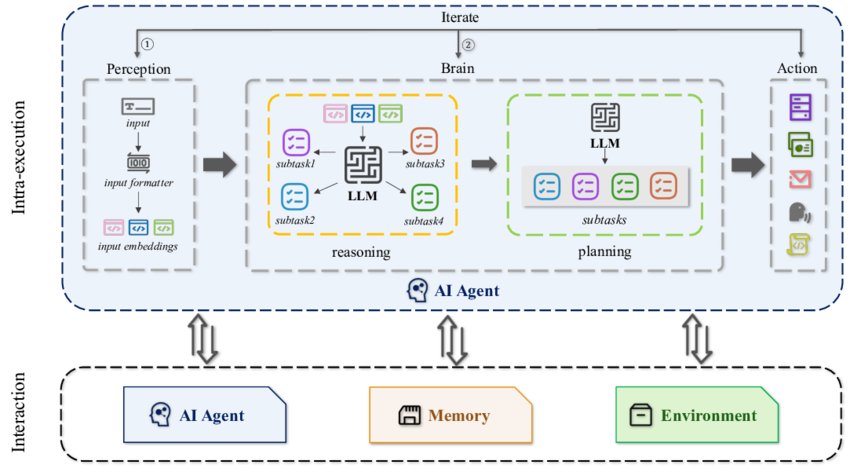
5. Execution Controller (Agent Loop)
This is the runtime brain.
Typical loop:
- Read current state
- Decide next action
- Execute tool or reasoning step
- Store results
- Check completion condition
Loop continues until:
- Goal satisfied
- Failure threshold reached
- Human intervention requested
Reference Architecture (Simplified)
User → Intent Parser → Planner → Agent Loop → Tools / Memory → Results
In production, each block becomes a separate service with logging, tracing, and policy enforcement.
Production Challenges Most Articles Ignore
State Explosion
Agents generate intermediate data rapidly. Without strict state pruning and storage strategies, systems become slow and expensive.
Tool Reliability
Agents assume tools behave deterministically. Real APIs fail, rate‑limit, or change schemas.
Observability
You must log:
- Decisions
- Tool calls
- Intermediate reasoning
- Memory writes
Without this, debugging is nearly impossible.
Governance
Autonomous execution introduces risk:
- Unauthorized data access
- Infinite loops
- Unsafe automation
Policy layers and permission models are essential.
When Should You Use Agentic AI?
Good fit:
- Multi‑step workflows
- Investigation tasks
- Automation pipelines
- DevOps assistance
- Enterprise internal tools
Bad fit:
- Single‑step Q&A
- Static predictions
- Deterministic workflows
- Latency‑critical endpoints
Final Thoughts
Agentic AI is not just “LLM + tools”. It is a distributed software system that combines reasoning models, workflow engines, memory infrastructure, and operational safeguards.
Teams that treat agents as simple prompt wrappers often face reliability, cost, and governance failures. Teams that design them as production systems unlock powerful automation capabilities.
The shift from AI assistance to AI execution is already underway. Understanding the engineering foundations now will determine who can build reliable autonomous systems at scale.
🚀 Join the Community & Stay Connected
If you found this article helpful and want more deep dives on AI, software engineering, automation, and future tech, stay connected with me across platforms.
🌐 Websites & Platforms
- Main platform → https://pro.softwareengineer.website/
- Personal hub → https://kaundal.vip
- Blog archive → https://blog.kaundal.vip
🧠 Follow for Tech Insights
- X (Twitter) → https://x.com/k_k_kaundal
- Backup X → https://x.com/k_kumar_kaundal
- LinkedIn → https://www.linkedin.com/in/kaundal/
- Medium → https://medium.com/@kaundal.k.k
📱 Social Media
- Threads → https://www.threads.com/@k.k.kaundal
- Instagram → https://www.instagram.com/k.k.kaundal/
- Facebook Page → https://www.facebook.com/me.kaundal/
- Facebook Profile → https://www.facebook.com/kaundal.k.k/
- Software Engineer Community Group → https://www.facebook.com/groups/me.software.engineer
💡 Support My Work
If you want to support my research, open-source work, and educational content:
- Gumroad → https://kaundalkk.gumroad.com/
- Buy Me a Coffee → https://buymeacoffee.com/kaundalkkz
- Ko-fi → https://ko-fi.com/k_k_kaundal
- Patreon → https://www.patreon.com/c/KaundalVIP
- GitHub Sponsor → https://github.com/k-kaundal
⭐ Tip: The best way to stay updated is to bookmark the main site and follow on LinkedIn or X — that’s where new releases and community updates appear first.
Thanks for reading and being part of this growing tech community!
#agentic ai #ai agents #ai architecture #ai engineering #autonomous ai #llm agents #multi agent systems